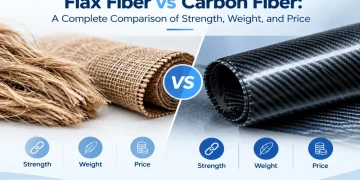
One of these grew in a field. The other was born in a furnace.
Somewhere in a field right now, a crop is growing that race teams are bolting onto cars. Flax, the same plant that gives us linen shirts and linen closets, has quietly become a legitimate composite reinforcement, sitting in the same conversation as carbon fiber in places you would not expect. It will not replace carbon everywhere. But it has already replaced it somewhere, and that somewhere is growing.
What Flax Composite Actually Is
Flax fiber composite works exactly like carbon fiber composite in structure: strong fibers, woven or laid into a matrix of resin, cured into a rigid laminate. The difference is what the fibers are. Instead of carbonized synthetic filaments baked at over 1,000 degrees, flax fibers are harvested, processed, and spun from the stem of the flax plant. The result is a natural fiber composite with a remarkable property set, and a remarkably different footprint. The flax vs carbon fiber comparison puts the numbers side by side.
In the hand and to the eye, the material announces its origins. Flax fabric has a warm, tan, woven look, more canvas than carbon, and most parts either embrace that aesthetic with a clear finish or hide it under paint. It feels less like a spaceship and more like a very serious tennis racket. Some builders love exactly that; others want the black shimmer and nothing else. Both instincts are correct.
The Numbers, Honestly
Carbon fiber remains the performance king, and honesty demands saying so first. Carbon’s tensile strength runs roughly 3,000 to 7,000 MPa against flax’s 500 to 1,500. Stiffness tells the same story: 230 to 640 GPa for carbon, 30 to 70 for flax. On pure structural performance, it is not close, and for load-critical parts it will not be close for a long time. But here is where it gets interesting: flax is lighter, at 1.4 to 1.5 g/cm³ against carbon’s 1.75 to 1.95, and it does two things carbon cannot do at all.
The Two Things Flax Wins
First: vibration. Flax fibers damp vibration up to five times better than carbon. Where carbon transmits road noise and buzz like a tuning fork, flax absorbs it. Which is why it first appeared in motorsport bodywork and interior panels, places where stiffness matters less and harshness matters more. Second: the planet. Producing flax fiber generates a fraction of carbon fiber’s emissions, figures around 85 percent lower are commonly cited, because the plant did the chemistry with sunlight instead of a furnace.
Who Is Already Using It
This is not science-fair material. Porsche has raced flax composite bodywork. BMW’s electric programs have used natural fiber composites in production. McLaren has built racing seats from flax. When companies with unlimited engineering budgets put a material on race cars, the material has passed tests that matter. The carbon fiber material basics show the bar those programs are comparing against. And flax cleared enough of it to earn the seat.
Where Carbon Still Rules
- Anything structural or load-critical: chassis, suspension, aero under real load. Carbon’s strength margin is not negotiable.
- High-heat zones: flax resin systems and fibers dislike heat more than carbon’s.
- Precision stiffness: when a part must not flex, carbon’s modulus wins by an order of magnitude.
- The look: the woven shimmer of carbon remains its own category. Flax has its own aesthetic, more organic, more fabric-like, which some builds will love and others will not.
The Moisture Question
Flax’s honest weakness is water. Plant fibers absorb moisture, and uncontrolled absorption swells fibers and degrades the laminate. Modern treatments and resin systems manage this well, the race cars running flax bodywork are not melting in the rain, but it remains an engineering consideration rather than a solved non-issue. It is one more reason flax is colonizing interiors and bodywork before it approaches structure.
The Cost Question
Price is the surprise in this rivalry: flax fabric typically costs less than aerospace-grade carbon fabric, and it processes on the same equipment with the same skills. The finished-part price gap narrows because labor and tooling dominate both materials’ costs. But at the material level, the plant is the cheaper input. As volumes scale, expect flax parts to undercut equivalent carbon panels on price as well as weight and emissions.
Hybrid layups are the quiet middle path already in production: carbon plies where stiffness concentrates, flax plies where damping and weight matter. The laminate is tuned like an equalizer, band by band. Several premium manufacturers already ship interiors built exactly this way, and the occupants never know, which is rather the point.
The Verdict So Far
Flax is not coming for carbon fiber’s crown. It is coming for the jobs carbon was overqualified for. Interior panels, bodywork where vibration lives, applications where the environmental bill matters. The future is probably not flax or carbon. It is flax and carbon, each planted where it belongs. Materials do not have to fight. They can specialize.